
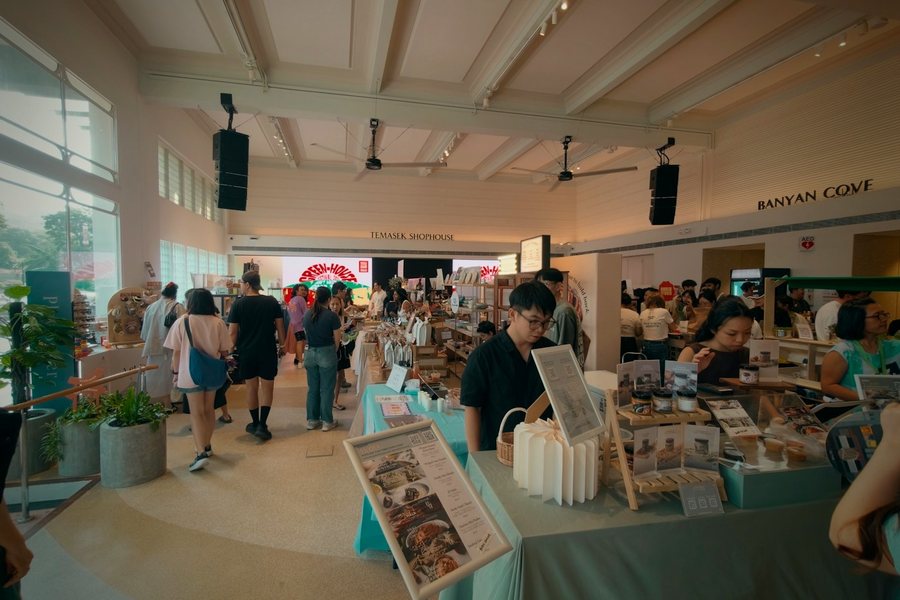
Footfall is not a result. It is a cost you already paid.
Ask most brands how their activation went and you will hear a number of people, a number of impressions, and a description of the atmosphere. Ask what it produced and the room goes quiet.
This is not because experiential marketing does not work. It is because most activations are designed as events rather than as the middle of a funnel — there is a beginning and a middle, and no end.
Design backwards from the transaction
Before anything else is decided, answer: what do we want a person to do, and when? There are only four honest answers.
- Buy now. On site, in the moment. Requires the product present and payment frictionless.
- Buy later. Requires capture — you must leave with a way to reach them.
- Come back. Requires a specific reason and a date.
- Tell someone. Requires something worth photographing and a reason to attribute it to you.
Pick one as primary. Activations trying to do all four do none.
The capture mechanism
This is where most activations fail, and it is entirely solvable. If people leave without you knowing who they were, you bought an afternoon.
What works, roughly in order:
- A trade, not a request. Something real in exchange for contact details — the photo taken at the activation, a genuine discount, entry to something limited.
- One field. Every additional field costs you a meaningful share of completions. Email or phone. Not both, not a name, not a birthday.
- Delivered immediately. The follow-up should arrive while they are still in the room.
- A reason to keep it. A code that expires in ten days converts far better than an open-ended one.
The three-day window
Most activation value decays within seventy-two hours. What happens in that window matters more than anything that happened at the event.
- Same day: the promised thing arrives — the photo, the code, the content.
- Next day: the recap published while people are still tagging you.
- Day three: the offer, with the deadline stated plainly.
- Day seven: the reminder that converts the people who meant to and forgot.
Build this before the activation, not after. Nobody has ever built a good follow-up sequence the week after an event.
Numbers worth tracking
- Capture rate — contacts collected divided by attendees. Under 20% means the trade was not good enough.
- Cost per captured contact — total activation cost divided by contacts. Compare it honestly against what you pay for a lead through paid media.
- Redemption rate on whatever you issued.
- Revenue at thirty and ninety days from captured contacts.
- Content produced per dollar — often the largest and least-counted return.
What makes people actually stop
Three things, consistently: something to do rather than look at, something worth photographing, and a person who talks to them like a human rather than a brand ambassador reading a script.
What does not: a branded wall, a queue, and a table of people in matching shirts waiting to be approached.
The bottom line
An activation is a media buy with a physical location attached. Design it backwards from the action you want, build the capture mechanism before the creative, and write the follow-up sequence before the doors open.
For activations at scale in Miami, see the Art Basel playbook and the F1 Miami breakdown.
Planning an activation that has to produce revenue? Let's talk.